Winter Burning Man: What Davos Week Actually Feels Like
It's weirder than a conference.
Davos has been called the "Burning Man for billionaires." That's not quite right. It's stranger.
Burning Man has art cars and dust storms. Davos has SUVs and snow. Same temporary city energy. Same FOMO driving you between events. Same comedown on Monday when you realize the real world still exists. Just colder, fewer art cars, and someone will definitely ask for your business card.
Here's what it actually feels like when you're there for the first time.
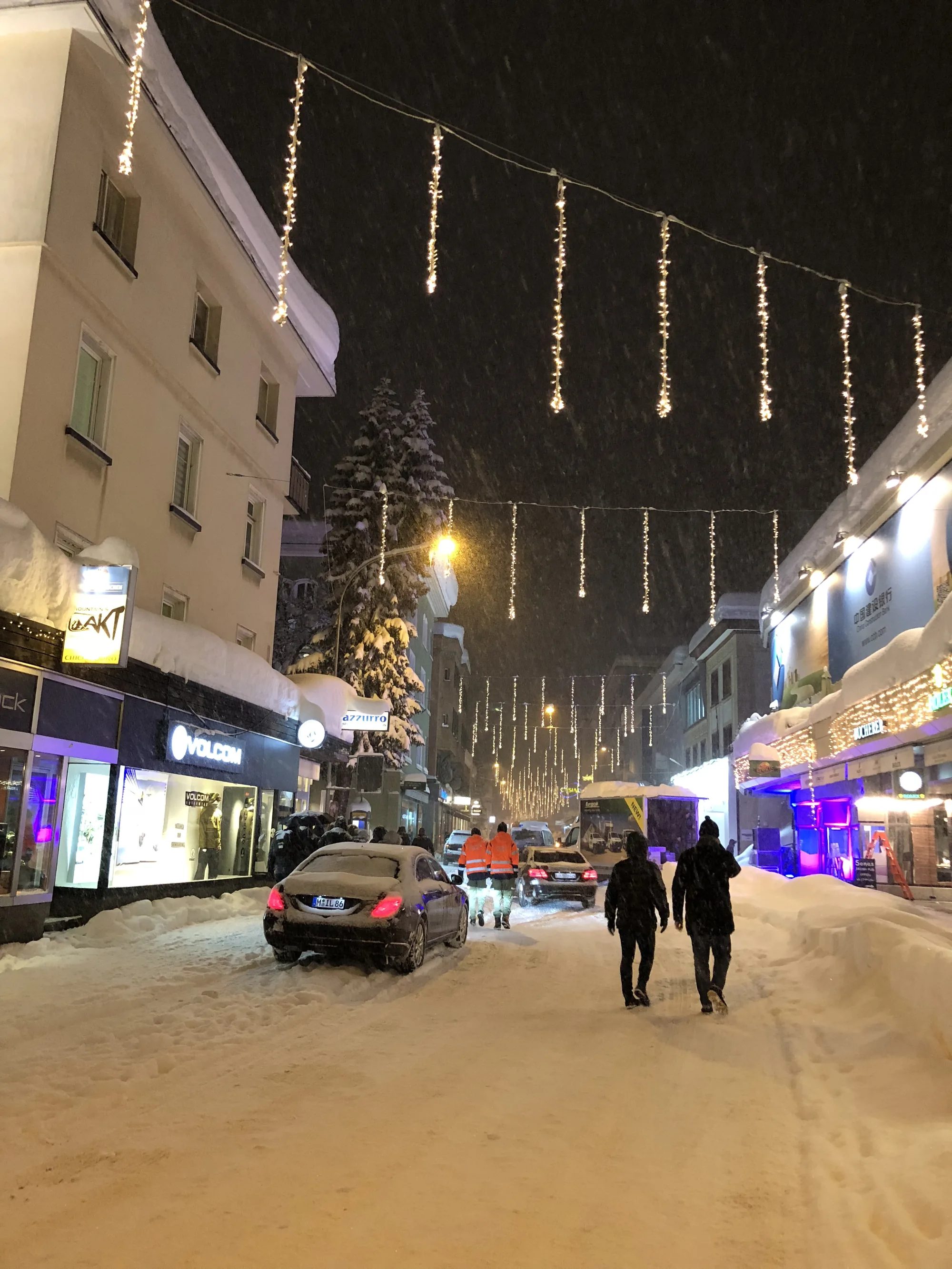
The Davos Sprint
You can have everything booked. Calendar color-coded. Badge arranged. Invitations confirmed. You can arrive knowing exactly which breakfast you're supposed to attend at 6:30 on Tuesday morning.
And still have no idea what the week is going to feel like.
A 6:30 alarm. A 7:30 breakfast. A panel. Another panel. A walk across the Promenade. A coffee. A meeting. A hotel lounge. Another introduction. Back outside into the cold. Back inside. A dinner. A reception. The nightcap at the hotel where you need an RSVP and a badge to enter. Another conversation. And suddenly it's midnight. Sometimes later.
The distance between two venues can be short on a map and feel much longer when you're carrying a laptop, wearing formal clothes, and walking over packed snow. You spend the day moving between temperatures designed to confuse the human body: freezing streets, warm hotel entrances, heated conference rooms, cold again, then another crowded room.
By Wednesday, you understand the phrase "Davos Sprint." The tiredness isn't just physical. You've been paying attention all day — remembering names, reading rooms, listening, talking, making introductions, deciding whether to stay or leave, checking your phone, changing plans, trying to be present in one conversation while knowing you're supposed to be somewhere else in twenty minutes.
It's fun and exhausting at the same time.
Wednesday and Thursday: The Main Event
If you're planning your week, know this: Wednesday and Thursday are when the town is full.
Monday is arrival day. Tuesday, people are still finding their feet. By Wednesday morning, everyone is there. Every country house is open. Every reception is packed. Every conversation is happening at once.
Thursday is the peak. The Promenade is shoulder-to-shoulder. Events run back-to-back from 6:30am to past midnight. If you have a meeting that matters, this is when it happens.
Friday morning, the exodus begins. People start heading to the airport. The energy drops noticeably. Some of the best quiet conversations happen on Friday afternoon — but the frenzy is Wednesday and Thursday.
Plan your important meetings for those two days. Protect your energy on Tuesday so you have something left. And don't book your flight out before Friday evening unless you absolutely have to.
A Practical Detail Nobody Mentions: Phone Charging
Your phone will die. This is not a metaphor.
Between navigating the Promenade, checking invites, taking photos of panels, messaging contacts, and trying to find which entrance your 2:30 meeting is actually using, your battery won't last the day.
Here's what experienced attendees know:
Hotel lobbies are the best charging spots. Most major hotels along the Promenade have public areas with outlets — Hotel Seehof, the Steigenberger Grandhotel Belvédère, Hotel Flüela and the AMERON Swiss Mountain Hotel all have lobbies you can sit in for twenty minutes without anyone questioning it. If you don't spot an outlet immediately, ask at reception — they'll usually point you to one.
Country houses often have charging stations tucked away near registration desks. They don't advertise them, but they exist. If you're invited to a pavilion, ask the person at the door — they usually know.
We've heard the WEF Media Centre has charging facilities for accredited press — worth asking if that's your badge type. If you're not carrying a media badge, it's not worth the walk to find out.
What not to do: Don't stand in a corner of a busy reception with your back to the room, plugged into a wall, staring at your phone. That's not charging — that's announcing you're alone and not talking to anyone. Take your charger, find a quiet hotel lobby, sit down, answer emails, and charge for twenty minutes. You'll feel better and your phone will survive the sprint.
Walking the Promenade
You may have seen photographs of Davos during WEF week. They don't quite capture it.
The Promenade becomes a temporary international city. Hotels become meeting points. Ordinary premises become temporary houses, lounges, studios, and event spaces. Country pavilions sit alongside corporate activations, media operations, private receptions, and restaurants full of people who have been trying to arrange the same meeting for six months.
Everyone appears to be moving with purpose. Some people are. Some are pretending. And some have been walking around for twenty minutes trying to find the correct entrance.
You will see people you recognise from television. You will hear several languages in the space of a few minutes. You will see security, badges, lanyards, invitations, wristbands, and people constantly checking their phones.
And underneath all of it is one very ordinary human feeling:
Where exactly am I supposed to be?
That feeling doesn't completely disappear, even when you've been coming for years. You just become better at handling it.
For the full field guide — how access actually works, the invitation economy, and how to build your week — see The Parallel Davos guide.
The Strange Experience of Being Somewhere Important
You can be surrounded by extraordinarily important people and still feel slightly out of place.
You enter a reception and see three groups already deep in conversation. You recognise somebody from the news. Someone else clearly knows the host. You have a perfectly legitimate reason for being there.
And still, for a moment, you stand near the edge of the room wondering whether you should walk over.
This happens to men. It happens to women. It happens to people with impressive titles. It happens to first-timers and, occasionally, to people who have been coming for years.
The difference is often not confidence. It's context. Knowing who is there. Knowing why you're there. Knowing who can make the right introduction.
The Social Geography of Davos
Davos is not the same room for everyone. The experience shifts depending on who you are, how you arrive, and who you know.
If you're a woman attending alone, you notice the social geography of a room quickly. Some groups are open. Some are not. Some conversations can be joined naturally. Some are closed circles you'd need a crowbar to enter.
You learn that you don't need to force yourself into every circle. A warm introduction changes everything. Someone who knows both people says: "You should meet." Suddenly the context is there. You don't have to explain yourself from the beginning. You just start talking.
There are more women at Davos than there used to be. Plenty of women-focused events now exist — we've written up the fuller picture on Women at Davos. But the social dynamics still reward warm introductions over cold approaches.
If you're a man attending alone, the challenge looks different. A senior title doesn't automatically make somebody available. A high-level badge doesn't guarantee a useful conversation. Filling your calendar with fifteen-minute introductions can leave you with a very full schedule and surprisingly few memorable relationships.
The temptation is to treat Davos like a trade show. Walk. Collect contacts. Move to the next room. Repeat.
But the most useful connection of the week might happen while waiting for coffee. Or because someone introduces you to someone who wasn't on your original list. Or because you stayed at dinner another twenty minutes.
The underlying lesson is the same for everyone: Davos works better when you're thinking about people, not numbers. And warm introductions beat cold approaches every single time.
Solo vs. Team
Going alone can actually be one of the best ways to experience Davos. You have freedom. You can change your plans. You can accept a last-minute invitation. You can stay for the conversation that is unexpectedly interesting instead of leaving because your colleague is waiting. You can follow your instincts.
But there's a trade-off. When you're alone, there's nobody beside you to say: Do we actually need to go to this? Nobody to divide the calendar with. Nobody to introduce you when you walk into a room. Nobody to tell you that the meeting you're rushing across town for is probably not worth the twenty-minute walk.
That's why going alone works best when you don't arrive completely alone. Have a few good conversations already arranged. Know a few people you can call. And, if possible, have someone on the ground who understands the week.
A group gives you the opposite advantage. There's built-in structure. People can divide events. Someone can attend the breakfast while someone else goes to the panel. You have colleagues to compare notes with. You can leave a reception early without feeling that you've abandoned your only opportunity to meet someone.
But there's a trap. You can spend the entire week with the people you arrived with. You have a perfectly efficient Davos experience and miss half of what makes Davos interesting.
The best teams know when to separate. The best solo attendees know when to connect.
Reduce Your FOMO
Here's something nobody tells you: you will miss things.
There are hundreds of side events during WEF week. You can't attend them all. You shouldn't try.
The people who enjoy Davos most are the ones who accepted that missing things is part of the experience.
The real advice:
- Decide what matters before you arrive. Pick three to five things you actually want to get out of the week. Build your calendar around those. Everything else is optional.
- The best conversations happen in the gaps. Between events. Over coffee. In the hotel lobby at 11pm. The schedule is scaffolding.
- "Where am I supposed to be?" is a normal feeling. It doesn't go away. You just stop letting it stress you out.
- You will be where you want to be. Not because you got into everything — because you chose what mattered and let the rest go.
Davos Is Not Where You Pitch
This is one of the biggest misconceptions about the week.
The serious meetings are usually arranged before you arrive. The introduction happens beforehand. The request goes out. The meeting gets accepted. It appears in the calendar.
Then you arrive in Davos and finally sit across the table from the person you've been trying to reach.
That's the point. You don't spend the week walking up to strangers and delivering five-minute pitches.
The useful thing that happens in Davos is often much quieter:
- Someone introduces you.
- You continue a conversation.
- You discover that two people should know each other.
- You meet someone unexpectedly.
- You realise there's a shared interest.
- You leave with a reason to continue talking.
The pitch, proposal, or deal comes later. The follow-up might happen in London, New York, Geneva, Singapore, or three months later over a video call.
Davos is often where the relationship starts becoming real. Not where everything gets signed.
Protect Your Energy for Wednesday and Thursday
Wednesday and Thursday are when the town is full. Every country house is open. Every reception is packed. Every important conversation is happening.
If you burn out on Monday and Tuesday, you'll be useless when it counts.
The strategy: treat Monday and Tuesday as warm-up days. Go to a few things. Get your bearings. Don't fill every slot. Save your energy for the main event.
Wednesday morning: you should feel fresh. Not exhausted. Not running on fumes. Because Wednesday and Thursday are a marathon.
The mistake first-timers make: they treat Monday like it's Thursday. They go to everything. They stay out late. By Wednesday, they're running on coffee and adrenaline, and by Thursday they're barely functioning.
The experienced approach: pace yourself. Skip the Tuesday night reception that doesn't matter. Leave the dinner early if you're tired. Take an hour in the afternoon to sit somewhere quiet and answer emails. Your Wednesday and Thursday self will thank you.
The people who do Davos well are the ones who were actually present and useful when it mattered.
Stay the Weekend
If you can, stay through the weekend.
Friday is when everyone else leaves. The Promenade empties. The temporary structures start coming down. The town becomes quieter.
That's exactly why you should stay.
You've spent five days sprinting. Your body needs to reset. The altitude, the cold, the late nights, the constant conversations — it all catches up. The weekend gives you time to sleep properly, eat normally, and let your brain catch up to everything that just happened.
Go to a spa. Switzerland has incredible thermal baths and wellness centres. A few hours in a hot spring or a sauna will undo more of the week's damage than you think. Some options within reach of Davos:
- Bad Ragaz — about an hour away, famous thermal baths.
- Leukerbad — a bit further, but the biggest thermal spa in the Alps.
- The local hotel spas — plenty of places in Davos itself have solid wellness facilities.
The people who stay the weekend leave feeling like they actually recovered from the week. The people who fly out Friday afternoon arrive home exhausted and take days to feel normal again.
Stay. Rest. Then head home.
And Then the Week Disappears
Friday comes quickly. The Promenade begins to empty. Temporary structures start coming down. The town becomes quieter.
And the strange thing is how quickly it changes. A few days earlier, the Promenade felt like the centre of the world. Now it looks like a Swiss mountain town again.
You leave with fewer things than you expected:
- A few names.
- A few conversations.
- A few ideas.
- Perhaps an introduction that needs following up.
- Perhaps a panel opportunity that started with a conversation over breakfast.
- Perhaps nothing tangible yet.
That's fine. The real value of Davos is often measured later. Weeks. Months. Sometimes years.
So What Is Davos Week Actually Like?
Early mornings and late nights. Cold streets and overheated rooms. Bad sleep and very good conversations. Walking further than you planned. Standing outside a door wondering whether you have the right invitation. Finding yourself in a room you didn't expect to enter. Meeting somebody because a person you know says: "Come, I want you to meet someone."
Intense. Sometimes lonely. Sometimes funny. Occasionally frustrating. And sometimes extraordinarily useful.
The people who get the most from it are the ones who understand why they came, who they want to meet, where they can contribute, and when to stop chasing the next room. The badge and the calendar matter less than that.
Frequently asked questions
What time do events start?
Any time from 6:30 a.m. onward. Check the location as well as the time.
Do I need a WEF badge?
Not necessarily. Different doors want different things — some want a badge, some want a guest list, some want an invitation, some want an introduction. There's no single rule. If you only get one thing, make it a Hotel Badge — see our badge guide for what each type actually opens, or contact us and we'll help you work out which one you need.
Is walking practical?
Yes — often faster than a car or the shuttle bus. Wear boots you can actually move in, inside and outside.
When should I book meetings?
Before you arrive. The good slots go early. Need help lining them up? Get in touch and we'll help you plan the week.
When are the busiest days?
Wednesday and Thursday. That's when the town is full. Plan your important meetings for those days.
Should I stay the weekend?
If you can, yes. Stay, rest, go to a spa. You'll arrive home feeling human instead of destroyed.
Where can I charge my phone?
Hotel lobbies are your best bet — most major hotels along the Promenade have public areas with outlets. Don't stand in a corner of a busy reception doing it. Find a quiet lobby, sit down, and take twenty minutes.
Can you help with introductions or speaking?
Yes — but start early, since the good introductions take lead time. Contact us and we'll see what we can do.
Where to Next
- First time? First-Time Davos Manual
- What can you actually get into? Badge & Access
- Where to sleep? Where to Stay
- Want someone to navigate it with you? Contact
Got a Davos myth we should bust?
We've heard a lot over the years. We probably haven't heard yours. This is a living page — useful submissions will be added over time.
Send us the advice you've seen online, the rule someone told you, or the thing that happened to you that didn't match what you had read.