The History of Davos Side Events
Most of Davos has always happened outside the official programme. Here's how a small, formal management conference in the Alps grew a second, parallel week alongside it — one built from Houses, dinners and media hubs rather than panel agendas — and how that parallel week became, for most people, the actual Davos.
How it started: private conversations (1971–1980s)
In February 1971, around 450 executives, European Commission officials and academics from 31 countries gathered in Davos for something called the European Management Forum — a conference organised by a young German economist named Klaus Schwab to talk through what he called "stakeholder capitalism," an alternative to the shareholder- first model most Western companies ran on. There was no Promenade full of branded storefronts. There was no side programme at all. There was a room, a set of sessions, and an atmosphere Schwab wanted deliberately informal enough that people would actually say what they thought — what the Forum still calls the "Davos Spirit" today.
The organisation renamed itself the World Economic Forum in 1987, by which point its scope had already outgrown management theory and started pulling in economics and politics alongside business. But for most of that first decade and a half, whatever happened at Davos happened inside the room. The idea that anything worth talking about might happen in a hotel bar or a rented storefront hadn't occurred to anyone yet — mostly because the town hadn't filled up enough for it to be true.
When the informal layer made history — early diplomatic moments
The first sign that Davos could do something an official summit couldn't came in 1986, when Turkish Prime Minister Turgut Özal and Greek Prime Minister Andreas Papandreou — leaders of two countries that had come close to war over the Aegean and Cyprus — met informally on the sidelines. Two years later they came back, and with Schwab personally shuttling between Athens and Ankara in the run-up, signed what's remembered as the Davos Declaration: a joint commitment to normalize relations. Özal later told Schwab that without that first Davos meeting, war would have been unavoidable. The underlying disputes — Cyprus, minority rights, the military balance in the Aegean — were never fully resolved, and the goodwill didn't hold. But historians still mark 1988 as the moment Davos proved it could produce something a formal negotiating table couldn't.
The clearest example came in 1992. Nelson Mandela, released from prison two years earlier, appeared on a Davos stage alongside South African President F.W. de Klerk and Zulu Chief Mangosuthu Buthelezi — their first joint public appearance outside South Africa, at a genuinely fragile point in the country's transition. Mandela used the moment to give his first speech on what the ANC's economic policy would actually look like in power, and later told journalist Anthony Sampson that conversations with other leaders at Davos that week changed his thinking on nationalizing the mining industry outright. A year later, Mandela and de Klerk shared the Nobel Peace Prize. None of this was on an official agenda in the way a keynote is — it happened because the room was full of the right people at the right moment, which is exactly the logic the entire side-event ecosystem would later be built on.
The parallel ecosystem grows (1990s–2000s)
Through the 1990s, Davos increasingly became shorthand for something bigger than the Forum itself — a week where global economic conversations converged on one small Alpine town, whether or not those conversations were happening inside the Congress Centre. The idea for what became the G20 is traced to talks at Davos in 1998, years before it took formal shape as an institution. By 2004, the phenomenon had its own name: political scientist Samuel Huntington coined "Davos Man" in a Foreign Policy essay, describing a transnational elite — executives, academics, international civil servants — who had more in common with each other than with their own countries. Huntington was writing about a type of person, not a type of event. But naming the type was itself a sign that Davos had stopped being just a conference and started being a place people organized their year around.
That's the backdrop the Houses era grew out of: a town that filled up every January with more people than the Congress Centre could ever hold a badge for, most of whom still wanted somewhere to be seen, host a meeting or run their own programming — badge or no badge.
The Houses era — how the 2010s changed everything
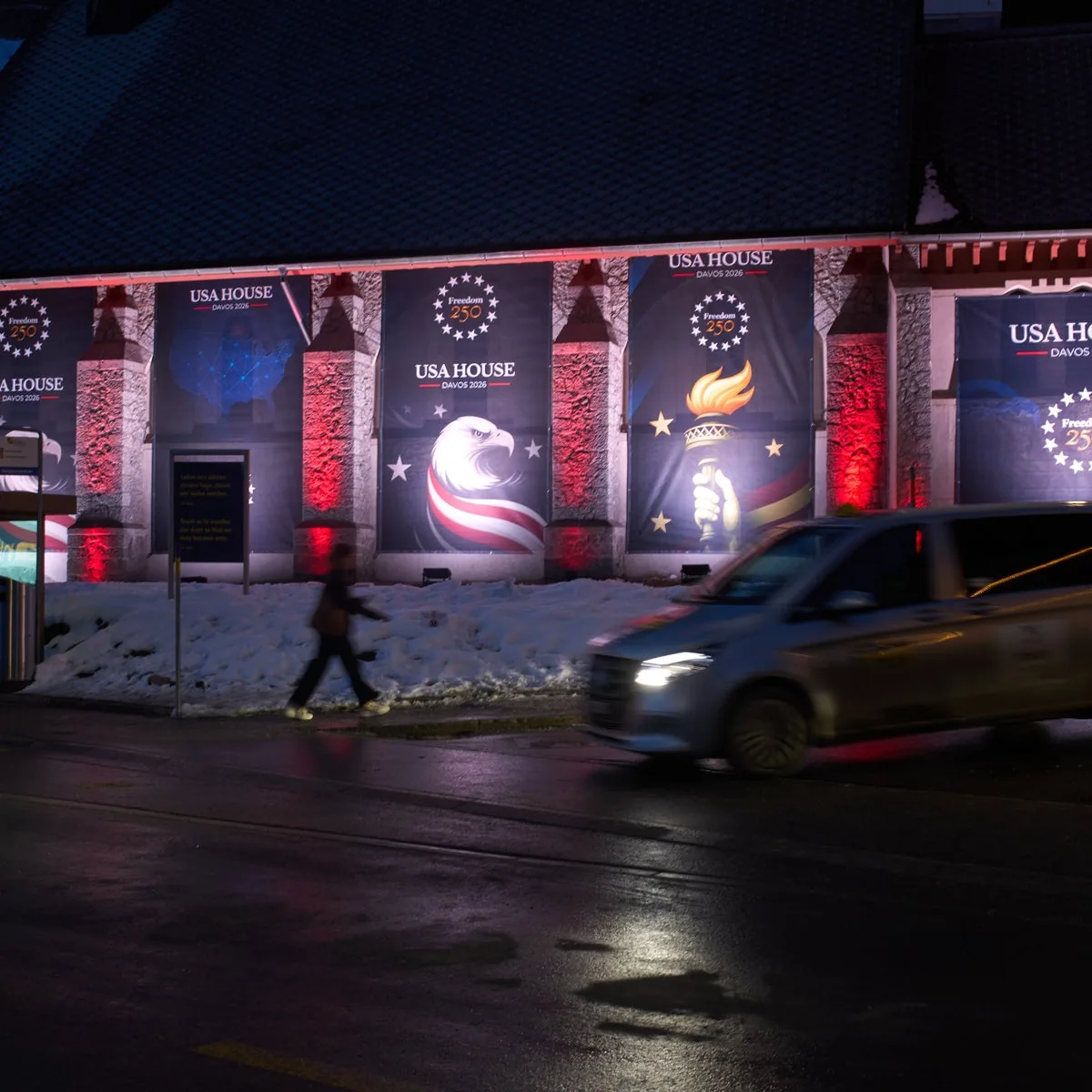
What changed in the 2010s was everything around the Forum's own agenda. For one week each January, ordinary Promenade storefronts started turning into something else entirely: coffee shops became corporate lounges, closed-for-winter boutiques became country pavilions, restaurants became invite-only dinner rooms. Companies with no official role in the Annual Meeting — Google, Facebook, Salesforce, HSBC among them — began renting whole buildings for the week and running their own programming inside them, independent of any WEF badge or agenda. A House, once it existed, needed no accreditation to speak at, host at, or walk into — just an invitation from whoever was running it that year.
By the time this was fully normal, the record of who was seen with whom had become genuinely newsworthy in its own right. In January 2019, a photo of Apple's Tim Cook and Microsoft's Satya Nadella at the same dinner table as Brazilian President Jair Bolsonaro — alongside Swiss President Ueli Maurer, New Zealand Prime Minister Jacinda Ardern and members of the Belgian royal family — circulated widely after CNBC reported on it, precisely because it captured something the official programme never could: who actually ends up at the same table, off the record, once the sessions end for the day.
What the side stage looks like today
The most striking recent proof of how fast a Promenade venue's meaning can flip came in May 2022. The building known as Russia House had hosted the Russian delegation for three straight years running. After Russia invaded Ukraine, it wasn't invited to that year's Annual Meeting at all — and within months, Ukrainian philanthropist Victor Pinchuk had funded the same storefront's conversion into Russia's War Crimes House, a photo exhibition documenting alleged war crimes using data from Ukrainian law enforcement and Amnesty International, timed deliberately to open during Davos week. CNBC and The Art Newspaper both covered it as one of the most talked-about things in town that year — not because the WEF programmed it, but because nothing stopped anyone else from renting the room next door and making a statement of their own.
That's still how it works. Houses, country pavilions and AI-branded activations now share the Promenade with embassies, media broadcast studios and private dinners, all running on their own budgets and their own guest lists, for the same week, independent of the official agenda and of each other. Davos's own municipality has recently started capping how many of these activations can exist in a given year — a real constraint on new venues, not on the side-event culture itself, which has nowhere close to run out of room to grow within it.
A typical speaker's week
None of this runs on one schedule. A speaker at a House breakfast panel on Monday might be on a completely unrelated dinner's guest list Tuesday night, booked through a different host, with no shared organiser and no reason the two would ever coordinate. Some sessions need an RSVP weeks out; others are a wristband handed out once and good for the rest of the week; a few are genuinely open, walk-in-off-the-street events with no list at all. The venues range from a converted shopfront with a stage built for the week to a hotel suite with eight chairs around a table. What they share is that none of it is run by the Forum, none of it needs a WEF badge, and none of it is written down anywhere in one place — which is still, more than fifty years into this, the actual logistics problem of attending or speaking at Davos.
The missing map
Every moment in this history — Özal and Papandreou, Mandela and de Klerk, Russia House becoming Russia's War Crimes House — got remembered because someone photographed it, reported it, or wrote it down afterward. In the moment, week-of, there's still no single place that tells you who's actually speaking where. That's the specific gap The Side Stage exists to close: a real index of side-event speakers and sessions for Davos 2027, built while the week is still being planned rather than assembled afterward from press clippings.
Frequently asked questions
When did the Davos side-event scene start?
The conference itself started in 1971, as the European Management Forum — small, formal, no parallel programme at all. The branded Houses, dinners and media hubs that make up today's side-event week are a much later layer, built up gradually and then rapidly through the 2010s as companies, countries and outlets started renting Promenade storefronts for the week rather than just sending delegates inside the Congress Centre.
What was the 1988 Davos Declaration?
An agreement between Turkish Prime Minister Turgut Özal and Greek Prime Minister Andreas Papandreou, brokered by WEF founder Klaus Schwab and signed at that year's Annual Meeting, aimed at normalizing relations between the two countries after tensions had nearly led to war. It's remembered as a real diplomatic moment that happened because of Davos, not just at it — though the underlying disputes it addressed were never fully resolved.
Why did Nelson Mandela and F.W. de Klerk appear together at Davos?
In 1992, Mandela, de Klerk and Zulu Chief Mangosuthu Buthelezi shared a Davos stage — their first joint public appearance outside South Africa, at a fragile point in the country's transition away from apartheid. Mandela later said conversations there shifted his own thinking on economic policy. The following year, Mandela and de Klerk jointly won the Nobel Peace Prize.
What happened to Russia House at Davos?
Russia's delegation used the building for three straight years before being disinvited from the 2022 Annual Meeting after the invasion of Ukraine. That same week, Ukrainian philanthropist Victor Pinchuk funded its conversion into Russia's War Crimes House — a war-crimes photo exhibition in the same storefront the Russian delegation had used the year before, timed deliberately to the Forum's own calendar.
Are Davos side events part of the official WEF programme?
No. Houses, dinners, pavilions and receptions are run independently by whoever's hosting them — companies, countries, foundations, media outlets — not by the World Economic Forum. Davos Access is not affiliated with or endorsed by the WEF; The Side Stage tracks the independent side-event programme specifically, not the official Congress Centre agenda.
Davos Access is not affiliated with the World Economic Forum. Historical details are drawn from public reporting.