Davos by the Numbers
How many people actually go to Davos, which countries show up, and how the side-event count has grown over the last decade — plus why the hottest room changes every single year.
Last updated: August 2026
The World Economic Forum's own count for the January 2026 Annual Meeting was close to 3,000 people — the largest in its history, 64 of them heads of state. The town itself swelled to roughly 30,000, according to CNBC and The Seattle Times. Those are two different numbers answering two different questions, and most coverage only ever gives you the first one.
Here is the whole thing in numbers, in two parts: the official meeting, then the much bigger side-event week around it — plus which subject owns the hottest room each year, and how fast that changes.
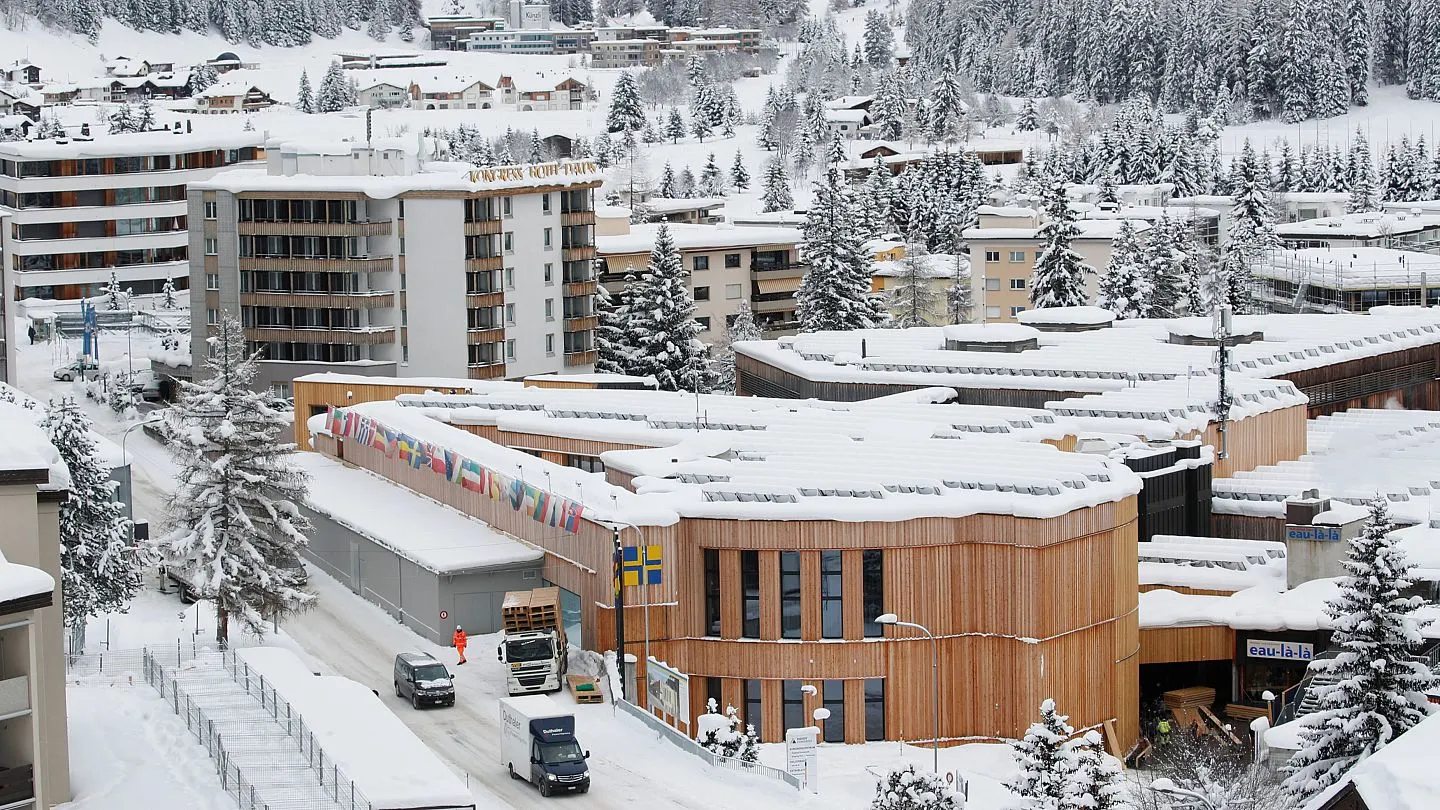
Part One — The Official Meeting
- Every figure in this part is the World Economic Forum’s own count for the Congress Centre — the number that gets reported as “how many people go to Davos.” It’s a much smaller story than the one in Part Two.
Attendance over the last decade
- This is the Forum’s own official delegate count for the Congress Centre — not everyone in Davos that week (more on that later in this piece). Since the pandemic cancelled the 2021 meeting outright, it has climbed back steadily, and 2026 set a record on almost every measure.
| Year | Participants | Countries | Note |
|---|---|---|---|
| 2021 | Cancelled | — | Covid. No Davos meeting held. |
| 2022 | ~2,000 | — | Held in May, not January. Plans to move it abroad were dropped. |
| 2024 | ~2,400 | — | Back to a January rhythm. |
| 2025 | 2,700+ | — | Highest since before the pandemic. |
| 2026 | ~3,000 | 130+ | Record on nearly every measure. |
| 2027 | ~3,000 expected | — | 18–22 January. Not yet held. |
Official Annual Meeting participants only — not the far larger crowd in town for the side events. 2027 is the organisers' expectation; the rest is as publicly reported.
The two years that broke the pattern
- 2021 is the only cancelled meeting in the Forum's history. The January edition was called off, an in-person replacement was floated for Singapore in May, then August, then dropped entirely.
- 2022 was the outlier: the meeting finally happened in Davos, but in May, on green grass instead of snow, with a noticeably thinner crowd.
- The return to January in 2023 is when the numbers restart their climb — and when the side-event ecosystem around the meeting, which had no reason to exist during the closed years, comes back much bigger than before.
Who is actually in the room
- The 56th Annual Meeting in January 2026 was the largest yet on nearly every measure, and unusually political: 400 government leaders, reported as the highest on record.
| What | 2026 figure |
|---|---|
| Participants | ~3,000 |
| Countries represented | 130+ |
| CEOs and board chairs | 830 |
| Heads of state and government | 64 |
| Government leaders (all levels) | ~400 |
| G7 heads of government | 6 of 7 |
| Finance and economy ministers | 55 |
| Central bank governors | 11 |
Which countries send the most people
- The United States dominates the room and always has — roughly 725 attendees in 2025, more than a quarter of everyone there. Switzerland, as host, and the UK each sent about 228.
- India reached 112 participants by 2025, close behind Germany and fifth overall. The United Arab Emirates now reportedly sends more people than France or China.
- Africa is the fastest-growing block by count of countries rather than count of people: nine African countries attended in 2025 that had not attended in 2024, including Algeria, Libya and Namibia.
- Russia has been largely absent since the invasion of Ukraine.
- And the concentration never really breaks: about two-thirds of all participants come from just ten countries. Single institutions field delegations the size of small nations — Harvard sent twelve people in 2025, not far behind the European Commission's fifteen.
What the 3,000 figure doesn't count
- CNBC and The Seattle Times have both reported the total directly: Davos's roughly 10,000–11,000 permanent residents swell to about 30,000 during the week — meaning something like 27,000 people in town that week hold no official Forum badge at all. Davos Access calls that crowd the Parallel Davos: unbadged founders, investors, security and hospitality staff, journalists, and the organisers of hundreds of side events.
- A lot of those residents simply leave for the week. Renting out a home during the Forum can reportedly bring in about three months' normal rent in a single week, and commercial space near the Congress Centre has gone for CHF 60,000–70,000 — enough that some tenancy agreements reportedly write a leave-during-WEF clause straight into the contract.
- What we track directly is the side-event half of that footprint: 497 events across 42 Houses for the 2026 week — more individual sessions than the roughly 300 the Forum runs itself. By that measure, the side-event week is bigger than the meeting it surrounds.
Part Two — The Side-Event Week
- This is the half of Davos that never shows up in the Forum’s own count. Everything from here is what Davos Access actually tracks: every side event, who gets into what, and which subject owns the room this year.
497 side events, outside the official programme
- In 2025, roughly 1,500 events ran alongside the official meeting — the Forum organised about 300 of them itself; everything else belongs to what people call the Davos Fringe. That's the Forum's own estimate; here's Davos Access's own count for the 2026 week, day by day. Wednesday, unsurprisingly, is the day to be in town if you can only pick one.
| Day | Side events tracked |
|---|---|
| Saturday before | 3 |
| Sunday | 11 |
| Monday | 83 |
| Tuesday | 108 |
| Wednesday | 146 |
| Thursday | 113 |
| Friday | 28 |
| Saturday after | 5 |
| Total | 497 |
Davos Access's own count for the 2026 week, not an official WEF figure. Wednesday is the busiest day of the year in Davos by a wide margin.
What it takes to get in
- Only 43 of the 497 side events we tracked were invite-only. Another 43 were open to anyone who walked in.
- The overwhelming majority — 380 events — simply required registration. Free, online, first-come. The real barrier at Davos is knowing an event exists in time.
| Access type | Events | Share |
|---|---|---|
| Registration required | 380 | 76% |
| Invite-only | 43 | 9% |
| Open to all | 43 | 9% |
| Application / vetted | 21 | 4% |
| Other (paid, livestream, mixed) | 10 | 2% |
The house that changes tenants
- This is the part that never makes the official numbers. Davos has a fashion cycle, and the Promenade rents itself out to whatever the market got excited about that year. The pattern is always the same: the money arrives first, the house follows about twelve months later, and then it either becomes permanent infrastructure or quietly disappears.
- The cleanest example is cannabis. There was no cannabis house in Davos in 2017 or 2018. The Canada Cannabis House launched in January 2019 — roughly three months after Canada legalised recreational cannabis federally in October 2018. Before that the sector simply did not have the public listings or corporate structure to finance a lounge on the Promenade. Legalisation created the balance sheets; the balance sheets bought the address.
- Psychedelics arrived at the strangest meeting of all. The Medical Psychedelics House of Davos debuted in May 2022 — the snowless, rescheduled edition — organised by the Energia Foundation and Tabula Rasa Ventures, running roughly 40 panel sessions with researchers including David Nichols and figures like Deepak Chopra.
- The programming deliberately avoided counter-culture framing and talked instead about clinical trials for treatment-resistant depression, regulatory pathways for PTSD therapy, biotech investment and insurance reimbursement models. By 2023 it had been folded into the broader House of Health.
- Longevity is the current occupant, and it has skipped the single-house stage entirely. It is anchored by repeat summits — the Longevity Investors Lunch, the Future Investments Circle — and spread across existing addresses rather than building its own. In our 2026 tracking that means a six-hour Longevity Investors Lunch at the Seehof, a panel on "the Investment Implications of the Longevity Economy," a session inside Kearney's Glass House, and AI House at Promenade 67 hosting "The Leap to Longevity: Forever Healthy."
- Crypto went the other direction. After years where the Promenade filled with token projects and exchange lounges — several of which had gone bankrupt by the following January — the 2026 footprint has largely consolidated onto one address. Fourteen sessions across the week carry Web3 in the title, and nine of them run at the same venue: Web3 Hub at Obere Strasse 33. The remainder is a Blockchain Central and a CryptoMondays night at USA House.
- Quantum computing is the clear 2026 arrival with 12 separate sessions, including Kearney opening its Glass House at 7:30am with "The Quantum Reckoning: When Does the Future Arrive?" and WISeKey running a quantum-AI roundtable at the Morosani Schweizerhof.
- Brain and mental health became one of the largest clusters of all, at 18 sessions across Brain House at the ICON, Goals House and the TPC House — including a full Mental Health Day at the Heimatmuseum and a panel titled "From Chatbot Suicides to AI Psychosis." Fusion made its first real showing with sessions on plasma stabilisation and commercialisation coalitions. Agentic AI replaced generative AI as the phrase in the room.
| Year | What arrived | What triggered it |
|---|---|---|
| 2019 | Canada Cannabis House | Canada legalised recreational cannabis federally in October 2018 |
| 2022 (May) | Medical Psychedelics House of Davos | ~40 sessions on clinical trials, PTSD regulation and reimbursement — not counter-culture |
| 2023 | House of Health | Psychedelics programming folded into a broader wellness umbrella |
| 2026 | Quantum — 12 sessions | Kearney's Glass House, WISeKey, the TPC House and the Open Forum |
| 2026 | Brain and mental health — 18 sessions | Brain House at the ICON, Goals House, a full Mental Health Day |
| 2026 | Longevity — 5 sessions | Investor lunches rather than a house of its own |
| 2026 | Fusion — first appearance | Plasma stabilisation and commercialisation coalitions |
| 2026 | Crypto consolidates — 14 sessions | 9 of them at one address, Web3 Hub, after years spread across the Promenade |
Arrival years for the trend houses are as publicly reported; the 2026 session counts are Davos Access's own tracking.
Who builds a house, and who just sends people
- A growing number of countries build or run their own House for the week, on top of sending delegates. In 2026 the national presences we tracked included House of Switzerland, Belgium House, the India Pavilion, Ukraine House, Saudi House, USA House, Brazil House, Poland's Business Hub and Finland's Finnish Flow — plus Nigeria House, one of five first-time national presences that year.
- The media build too, and they build big: Bloomberg House, CNBC House, Axios House, Semafor Haus, Wall Street Journal House and FT Live all ran full programmes. Six outlets with physical real estate in a town of 10,000–11,000 people.
- The municipality has, for the first time, capped how many temporary structures can go up for 2027. The Houses that already hold their spot are fine — a new entrant building from scratch is in a much harder position than it was two years ago.
What is actually confirmed for 2027
- The 57th Annual Meeting runs 18–22 January 2027 in Davos, with roughly 3,000 attendees expected.
- Who will be leading the Forum by then is still an open question. Since Klaus Schwab's retirement it has been run on an interim basis by André Hoffmann of Roche and Larry Fink of BlackRock, both expected to stay in post at least through the January meeting.
- Reuters and NZZ have both reported that Christine Lagarde, currently President of the European Central Bank, was raised as a potential successor at a board meeting near Geneva, and told the board she is "ready to serve." That is reported board discussion, not a confirmed appointment.
Frequently asked questions
How many people attend Davos?
Close to 3,000 accredited delegates in 2026 — the largest on record — with roughly 3,000 expected again for 2027. That's the Forum's own Congress Centre count, not everyone in town that week.
How many people are actually in Davos during WEF week, not just the official delegates?
Roughly 30,000, according to CNBC and The Seattle Times — against the Forum's own 3,000 accredited delegates, meaning about 27,000 people in town that week hold no official badge. Most of Davos's 10,000–11,000 residents leave for the week and rent out their homes; the gap fills with unbadged founders, investors and side-event organisers — the Parallel Davos. We track its footprint directly: 497 side events across 42 Houses for 2026.
How many side events happen during Davos week?
Davos Access tracks 497 individual side events across 42 Houses for the 2026 week — more sessions than the roughly 300 the Forum organises itself. Wednesday is the busiest day, with 146.
Is Davos invitation-only?
The Congress Centre is. Side events mostly aren't: of 497 tracked for 2026, 380 just needed registration and 43 were open to anyone. Only 43 were invite-only.
Has Davos had a cannabis house or a psychedelics house?
Yes to both. The Canada Cannabis House launched in January 2019, three months after Canada's federal legalisation. The Medical Psychedelics House of Davos debuted at the rescheduled May 2022 meeting, running roughly 40 sessions on clinical trials and PTSD therapy rather than counter-culture themes, before folding into the House of Health by 2023.
Which country sends the most people to Davos?
The United States, by a wide margin — roughly 725 delegates in 2025, over a quarter of everyone there. Switzerland and the UK follow at about 228 each; India is fifth with 112.
Was Davos cancelled during Covid?
Yes — 2021 is the only cancelled meeting in the Forum's history. 2022 finally happened, but in May, on green grass, before the January schedule resumed in 2023.
How many heads of state attend Davos?
64 in 2026, alongside about 400 government leaders total, 55 finance ministers and 11 central bank governors — the highest political turnout on record.
When is Davos 2027?
18–22 January 2027, at the Kongresszentrum in Davos, Switzerland. It is the 57th Annual Meeting.
Is Davos Access affiliated with the World Economic Forum?
No. Davos Access is independent and not affiliated with or endorsed by the WEF. Official attendance figures here come from public WEF statements and reporting by CNBC, The Seattle Times, Reuters, NZZ, AP and Forbes; the 497-event side-event count is our own tracking.
Related reading: All 497 side events, searchable, Davos 2027, The Side Stage — who is speaking where
Sources: World Economic Forum — Annual Meeting 2026, CNBC — Davos's unofficial attendees, and the 30,000 figure, The Seattle Times — how Davos brings the global elite together, NZZ — sky-high Davos rents during WEF, France 24 — Davos residents renting out homes for WEF, Canadian Securities Exchange — Canada Cannabis House, Rolling Stone — cannabis at Davos, The Guardian — the Psychedelic House of Davos, Psychedelic Health — House of Health, Davos 2023
Got a specific question?
We've usually seen your exact situation before. Ask directly — no template reply.